- Q102014 = Wikidata item for hyperlink
- .xyz = the top-level domain famously adopted by Google for abc.xyz
- Q102014.xyz = a little middle finger to centralization. ;-)
Bring your research.
Bring your code.
Bring your hardware.
Build it.
Break it.
Learn.
Local autonomy. Global connectivity.
Q102014.xyz enables infrastructure for local autonomy and global connectivity.
As free, open, repairable and replicable as possible.
#PlanD Q102014.xyz inside 🍄🤖🖐️
“What is heavy should be local, and what is light should be global and shared.”
cosmolocal.world
- heavy = lokal: Hardware, Energie, Speicher, Produktion, Nahrung, Werkstätten, Rechner, Netze.
- light = global: Code, Protokolle, Wissen, Baupläne, Standards, Erfahrungen, Forschung.

Our Benchmarkers ;-)
…
THE QUESTION
How can a globally connected Alpine valley remain locally capable when central systems fail?
- Local autonomy.
- Global connectivity.
THE PROPOSITION
- As little technology as possible.
- As much autonomy as necessary.
- As free, open, repairable and replicable as possible.
Q102014.xyz develops enabling infrastructure for #PlanD.
COSMOLOCAL
“What is heavy should be local, and what is light should be global and shared.”
Hardware is local.
Energy is local.
Storage is local.
Production is local.
Networks are local.
Code can travel.
Protocols can travel.
Knowledge can travel.
Designs can travel.
Research can travel.
Learnings can travel.
The valley does not scale.
The infrastructure can be copied, adapted and recombined.
The learnings can travel.
SIX DESIGN PRINCIPLES
- Local First
Locally operable, self-hosted, offline-capable. - Free & Open
Free to access, copy, use, modify, redistribute, commercialize and fork. - Interoperable
Open standards, open interfaces, replaceable components. - Resilient
Redundant, repairable, restartable, no single point of failure. - Low Dependency
Minimal dependence on cloud services, vendors, external energy and specialist knowledge. - Federated
Locally autonomous, globally connected. Grow by federation rather than centralization.
SOFTWARE + HARDWARE + RULES = COMMONS INFRASTRUCTURE
The objective is not maximum technology.
The objective is infrastructure that can be operated, understood, repaired, copied and adapted locally.
Free where possible.
Open by default.
Gated where necessary.
Closed only where unavoidable.
BRING YOUR RESEARCH
Bring your theory.
Bring your code.
Bring your hardware.
Bring your protocol.
Bring your model.
Build it.
Break it.
Learn what survives.
THE TEST
PULL THE WAN CABLE.
Does the infrastructure still work when the normal infrastructure does not?
Disconnect telecom infrastructure.
Does it still work?
Disconnect external cloud services.
Does it still work?
Remove one compute node.
Does it still work?
Remove one network route.
Does the mesh find another path?
BUILD IT. BREAK IT. LEARN.
THE CLAIM
Everything that can be expressed unambiguously can eventually become infrastructure.
What can be formulated as a rule does not always need to be organized.
It can become protocol.
Code.
Interface.
Hardware.
Documentation.
A replicable process.
THE NEXT ORGANIZATION WILL NOT BE ORGANIZED.
Q102014.xyz
Part of #PlanD.
Q102014.xyz LOCAL MESH NODE
Local-first infrastructure for homes, farms and communities.
Mesh by default.
No cloud.
No telecom dependency.
No central operator.
Internet optional.
Compute · Storage · Network · Mesh · Power
1. Design principles
- Local-first
All essential services, data, communication and automation operate locally. - Mesh-first
Nodes communicate directly with each other. There is no central point that must remain available for the network to function. - Internet optional
Internet connectivity is an additional gateway to the outside world. It is never part of the operational core. - No telecom dependency
No SIM. No mobile carrier. No mandatory ISP service. No telecom infrastructure is required for local communication. - No cloud
Core services run on infrastructure physically controlled by its users. No cloud account, SaaS subscription or external authentication service is required. - No central operator
There is no organisation whose continued operation, permission or business model is required for the infrastructure to function. - Open protocols
Ethernet · IP · Wi-Fi · LoRa · MQTT · Matter · Thread · WireGuard · S3 · NFS · SMB · containers. - Physical ownership
Hardware, storage, cryptographic keys and administration remain locally controlled.
2. Cabinet
Rittal VX IT 19″ rack:
- 42 U
- 600 mm width
- 2,000 mm height
- 600 mm depth
- 19″ mounting system
- black safety-glass front
- floor-mounted
- mechanically anchored
- active ventilation at roof level
- integrated flush into existing cabinetry
- removable side and service panels
- rear service access
- kitchen plinth visually continued across installation
Reference:
The rack replaces one standard 600 mm kitchen cabinet module and is installed as infrastructure, not as furniture.
3. Core compute
19″ short-depth compute cluster.
- minimum 3 independent compute nodes
- AMD EPYC or equivalent server-class processors
- ECC memory
- minimum 128 GB RAM per node
- mirrored enterprise NVMe boot storage
- dual 25 GbE networking per node
- hardware watchdog
- redundant services distributed across nodes
- containerised workloads
- no dependency on proprietary cloud orchestration
The cluster continues operating when any single compute node fails.
4. Storage
MikroTik ROSE Data Server RDS2216.
- 1 U
- 20 × U.2 NVMe slots
- 8 × 7.68 TB enterprise NVMe installed initially
- 61.44 TB raw initial capacity
- expandable to 20 NVMe drives
- redundant storage
- snapshots
- encrypted datasets
- local S3-compatible object storage
- SMB
- NFS
- NVMe-over-TCP
- container support
- dual hot-swappable power supplies
https://mikrotik.com/product/rds2216
No subscription is required to access the data.
The data remains available inside the local network when the internet disappears.
5. Network backbone
MikroTik CRS518-16XS-2XQ-RM.
- 16 × 25 GbE SFP28
- 2 × 100 GbE QSFP28
- 1.2 Tbps switching capacity
- dual redundant hot-swappable power supplies
- redundant cooling
- VLAN
- LACP
- MLAG
- Layer‑3 hardware offloading
- local RouterOS administration
- 25 GbE connections to compute nodes
- 100 GbE storage backbone
https://mikrotik.com/product/crs518_16xs_2xq
The internal network does not depend on an ISP router.
6. Local wireless network
Wi-Fi 7 access infrastructure.
- 2.4 GHz
- 5 GHz
- 6 GHz
- wired 10/25 GbE backhaul
- multiple access points
- local controller
- local authentication
- local DNS
- local DHCP
- independent operation without WAN access
Wireless devices communicate locally even when no internet connection exists.
7. Long-range mesh
Meshtastic over LoRa.
- fixed outdoor rooftop node
- indoor gateway node
- portable battery-powered nodes
- encrypted peer-to-peer communication
- store-and-forward messaging
- multi-hop routing
- independent radio network
- no cell towers
- no SIM
- no ISP
- no internet
- no central server
The LoRa mesh remains operational independently of Ethernet, Wi-Fi and telecom infrastructure.
8. Local services
The node runs the community’s digital infrastructure locally.
- DNS
- DHCP
- identity
- authentication
- file storage
- object storage
- backups
- messaging
- Matrix
- Nextcloud
- MQTT
- Home Assistant
- Matter
- Thread
- sensor infrastructure
- camera infrastructure
- automation
- local websites
- databases
- API services
- container workloads
- local documentation
- local knowledge repositories
All essential services remain available inside the mesh without internet access.
9. External connectivity
The WAN connection is deliberately outside the operational core.
Internet access passes through a dedicated gateway and firewall.
- no inbound ports required
- no externally hosted controller
- no cloud identity provider
- no external DNS dependency for local services
- no external time service dependency
- no carrier-grade service required
- no SIM
- no proprietary remote-management tunnel
Remote access uses WireGuard.
If internet access fails, only communication with the external internet disappears.
The infrastructure itself remains operational.
10. Power
Dedicated electrical infrastructure.
- separate 230 V circuit
- 16 A minimum
- dedicated circuit protection
- surge protection
- online double-conversion UPS
- minimum 3 kVA UPS
- rack-mounted metered PDU
- power measurement per subsystem
- automatic shutdown sequence
- battery-backed network core
- battery-backed LoRa infrastructure
- connection prepared for local photovoltaic and battery storage
Critical communication and networking remain available for at least 30 minutes after grid failure.
Final electrical installation according to Swiss regulations by a licensed electrical installer.
11. Cooling
The rack is treated as technical infrastructure.
- cool-air intake at floor level
- front-to-rear airflow
- hot-air extraction at top level
- temperature-controlled fans
- redundant rack fans
- intake temperature sensor
- exhaust temperature sensor
- humidity sensor
- automatic temperature alarms
- automatic shutdown at critical temperature
- unobstructed rear airflow
- no enclosed kitchen cupboard around the rack
Design airflow:
approximately 350 m³/h per 1 kW thermal load at ΔT 10°C.
12. Security
- encrypted storage
- encrypted backups
- encrypted mesh communication
- local cryptographic keys
- hardware-backed key storage
- segmented VLAN architecture
- separate infrastructure network
- separate IoT network
- separate guest network
- firewall between network segments
- WireGuard remote access
- no mandatory external accounts
- no telemetry required
- offline recovery credentials
- offline backup copy
- physical rack lock
The owner controls the keys.
13. Resilience
The installation must tolerate failure.
- one compute node may fail
- one storage device may fail
- one power supply may fail
- internet may fail
- telecom networks may fail
- one wireless access point may fail
- individual mesh nodes may fail
- external DNS may fail
- external cloud services may fail
Essential local infrastructure continues operating.
14. Acceptance test
The final commissioning test is physical.
PULL THE WAN CABLE.
The following must continue to work:
- local network
- Wi-Fi
- storage
- local websites
- local databases
- messaging
- identity
- authentication
- sensors
- cameras
- automation
- device-to-device communication
- local administration
- LoRa mesh
- local backups
- Then disconnect telecom infrastructure.
- The system must continue operating.
- Then disconnect external cloud services.
- The system must continue operating.
- Then remove one compute node.
- The system must continue operating.
- Then remove one network route.
- The mesh must find another path.
- That is local-first.
- That is mesh.
- That is infrastructure.
THE NEXT ORGANIZATION WILL NOT BE ORGANIZED.
We build the infrastructure.
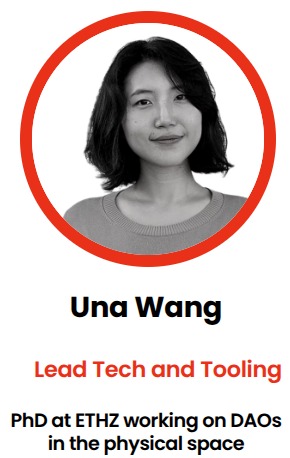
10. August 2027: 3 Sätze von Hongyang (Una) Wang, SwissDao und eine Frage:
https://doi.org/10.1016/j.autcon.2025.106309
- Tangible Artifact
“One key contribution in this shift is the creation of a tangible artifact.”
„Ein zentraler Beitrag zu diesem Wandel ist die Schaffung eines greifbaren, physischen Artefakts.“
- Physical Implementation
“The no1s1 prototype garnered significant attention due to its tangibility, as most blockchain research lacks systematic physical implementations.”
„Der #No1s1-Prototyp erhielt gerade wegen seiner Greifbarkeit grosse Aufmerksamkeit, da es der Blockchain-Forschung häufig an systematischen physischen Umsetzungen fehlt.“
- Self-Sovereignty
“If an intelligent building could achieve self-sovereignty, it could overturn existing long-held assumptions about human, social, and economic systems.”
„Wenn ein intelligentes Gebäude Selbstsouveränität erreichen könnte, könnte dies lange bestehende Annahmen über menschliche, soziale und wirtschaftliche Systeme auf den Kopf stellen.“
- QUESTION | Next-Level Experiment
“Una, if #No1s1 was a first stress test of self-sovereignty at the scale of an intelligent building, could an entire Alpine valley be the next-level experiment?”
„Una, wenn #No1s1 ein erster Stresstest von Selbstsouveränität auf der Ebene eines intelligenten Gebäudes war: Könnte dann eine ganze alpine Talschaft der nächste Versuch sein?“


Rosa @ #Caschlatsch | kind of kick of Q102014.xyz ;-)
DASHBOARD
öffnen und kommentieren | Vorschau:
Archiv | Stand des Eintrages vor dem 10. August 2027
THE BASIC QUESTION
How can a globally connected Alpine valley remain locally autonomous when central systems fail?
- Local autonomy.
- Global connectivity.
SIX DESIGN PRINCIPLES
- Local First
Locally operable, self-hosted, offline-capable. - Free & Open
Free to access, copy, use, modify, redistribute, commercialize and fork. - Interoperable
Open standards, open interfaces, replaceable components. - Resilient
Redundant, repairable, restartable, no single point of failure. - Low Dependency
Minimal dependence on cloud services, vendors, external energy and specialist knowledge. - Federated
Locally autonomous, globally connected. Grow by federation rather than centralization.
FROM SOFTWARE TO PHYSICAL INFRASTRUCTURE
The last decades built software infrastructure.
The next challenge is physical infrastructure.
Software
- Hardware
- Rules
= Commons Infrastructure
Software:
Linux
Git
Wikis
Databases
AI
Open Source
Open Standards
Open Interfaces
Local First
Offline First
Self-Hosting
Interoperability
Forkability
Replication
Redundancy
Documentation
Hardware:
Servers
Local Networks
Solar Systems
Batteries
Workshops
Storage
Mills
Seed Banks
Tools
Spare Parts
Cellars
Bunkers
The objective is not maximum technology.
The objective is infrastructure that can be operated, understood, repaired, copied and adapted locally.
FROM #No1s1 TO A VALLEY
#No1s1 asks whether a physical asset can gain agency.
#Q102014 asks what happens when the unit of autonomy becomes a territory.
HOUSE
↓
PHYSICAL INFRASTRUCTURE
↓
NETWORK
↓
VALLEY
Not a Smart Valley.
An autonomous, resilient and globally connected valley.
FROM ₿ITCOIN TO COMMONS INFRASTRUCTURE
₿ITCOIN decentralizes trust.
#Q102014 decentralizes the capacity to act.
Peer-to-peer infrastructure is not limited to money, data or digital organizations.
It can become physical.
Energy.
Food.
Communication.
Storage.
Mobility.
Knowledge.
Production.
Care.
The question is no longer only:
Who owns the infrastructure?
The question becomes:
Who can operate it?
Who can repair it?
Who can copy it?
Who can change it?
Who can restart it?
Who can keep it running when central systems fail?
BUILD IT. BREAK IT. LEARN.
#PlanD develops real-world stress tests.
Potatoes.
Bread.
Energy.
Communication.
Data.
Health.
Mobility.
The question is always the same:
Does the infrastructure still work when the normal infrastructure does not?
A stress test is not a simulation.
It is an experiment with real people, real hardware, real resources and real dependencies.
RULES BECOME INFRASTRUCTURE
Everything that can be expressed unambiguously can eventually become infrastructure.
What can be formulated as a rule does not always need to be organized.
It can become protocol.
Code.
Interface.
Hardware.
Documentation.
A replicable process.
The Next Organization Will Not Be Organized.
COMMONS BY DESIGN
#Q102014 builds infrastructure that is:
Local First.
Free & Open.
Interoperable.
Resilient.
Low Dependency.
Federated.
Free where possible.
Open by default.
Gated where necessary.
Closed only where unavoidable.
Local sovereignty does not mean isolation.
It means being able to stand alone and connect freely.
THE PROPOSITION | #Benchmarking
We are building and stress-testing decentralized physical commons infrastructure in a real Alpine valley.
Not as a model of withdrawal from the world.
As a model for remaining locally capable while globally connected.
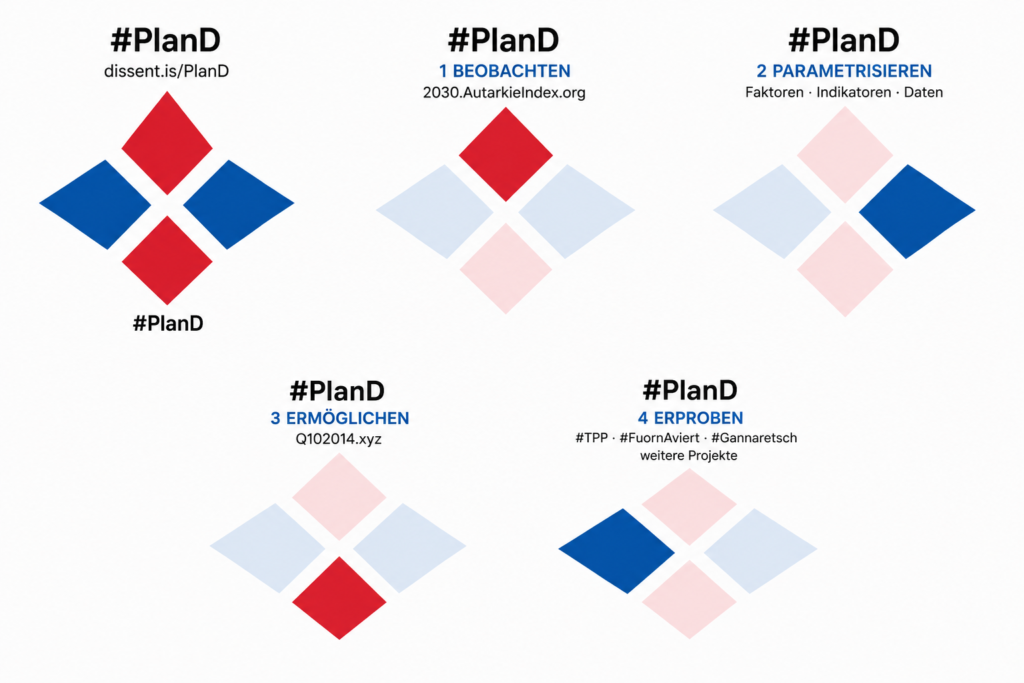
- #No1s1 → Agency (Hongyang Una Wang)
- Plan ₿ / Dyne.org → Sovereignty (Jaromil)
- Q102014.xyz / dissent.is/PlanD → Local Autonomy
7. August 2027 | ARCHIV
- As little technology as possible.
- As much autonomy as necessary.
- As open, repairable and replicable as possible.
#Q102014 is the infrastructure layer of #PlanD.
- Local First
Locally operable, self-hosted, offline-capable. - Free & Open
Free to access, copy, use, modify, redistribute, commercialize and fork. - Interoperable
Open standards, open interfaces, replaceable components. - Resilient
Redundant, repairable, restartable, no single point of failure. - Low Dependency
Minimal dependence on cloud services, vendors, external energy and specialist knowledge. - Federated
Locally autonomous, globally connected; grow by federation rather than centralization.
Its core assumption is simple: the major challenges of the 21st century will not be solved primarily through new laws or new organizations, but through new infrastructures for collaboration.
Instead of telling people what to do, we design environments in which beneficial action becomes easier.
Our work follows four steps:
- observe instead of ideologize
- parameterize instead of moralize
- enable instead of administer
- experiment instead of over-plan
The goal is neither more state nor more market.
We are interested in a third domain: commons infrastructures, where communities can develop, test, and continuously evolve their own rules.
#Q102014 therefore sees organizations not as the final destination, but as transitional forms toward self-sustaining social infrastructures.
Our guiding principle is:
Everything that can be expressed unambiguously can eventually become infrastructure.
no1s1 starts from the individual as the bearer of ownership. #Q102014 starts from communication as the medium of social coordination. Both projects explore how self-organization can emerge without centralized control.
While no1s1 begins with the self-owning individual, #Q102014 investigates the conditions under which resilient, open, and adaptive communities can emerge.
The focus is not on building the perfect organization, but on creating infrastructures that enable self-organization over the long term.
Q102014.xyz | dissent.is/PlanD
Home Of: Q102014.xyz Part of #PlanD “ERMÖGLICHEN” (enabeling) | The Surselva, an Alpine valley, has repeatedly developed its own answers to major historical transformations:
− 1424 Grey League
+ 1524 Free State of the Three Leagues
+ 1695 Baroque Reconstruction of Disentis Abbey
≠ 1877 Beyond State or Market #LavinaNera
# 2024 #PlanD asks how a globally connected Alpine valley can secure the foundations of a good life autonomously, resiliently and sustainably.
Q102014.xyz is the enabling infrastructure.
₿ITCOIN DECENTRALIZES TRUST.
Q102014 turns rules into infrastructure.
What can be formulated as a rule no longer needs to be organized: It can become infrastructure.
Q102014.xyz
M/ein Blog ist m/ein Kartenraum und k/eine Bühne. Ich weiss wie man publiziert. Das hier ist etwas anderes. d!a!n!k!e | WORK IN PROGRESS reload für aktuellen Schreibstand | Warum ich nicht publiziere? Weil ich es kann. Weil es geht. Weil ich es für angemessen halte.
AI is doing to the free and open internet what social media did to Web 2.0: enclosing data, information, and knowledge once again.
/sms ;-)
#Q102014 ist die Infrastruktur-Ebene von #PlanD.
Die Grundannahme ist einfach: Die grossen Herausforderungen des 21. Jahrhunderts werden nicht primär durch neue Gesetze oder neue Organisationen gelöst, sondern durch neue Infrastrukturen der Zusammenarbeit.
Anstatt Menschen vorzuschreiben, was sie tun sollen, gestalten wir Umgebungen, in denen gutes Handeln einfacher wird.
Unsere Arbeit folgt vier Schritten:
- beobachten statt ideologisieren
- parametrisieren statt moralisieren
- ermöglichen statt verwalten
- experimentieren statt durchplanen
Das Ziel ist weder mehr Staat noch mehr Markt.
Uns interessiert eine dritte Ebene: Commons-Infrastrukturen, in denen Gemeinschaften ihre eigenen Regeln entwickeln, erproben und kontinuierlich weiterentwickeln können.
#Q102014 versteht Organisationen deshalb nicht als Endpunkt, sondern als Übergangsform hin zu selbsttragenden sozialen Infrastrukturen.
Unser Leitsatz lautet:
Everything that can be expressed unambiguously can eventually become infrastructure.
no1s1 beginnt beim Individuum als Träger von Eigentum. #Q102014 beginnt bei Kommunikation als Medium gesellschaftlicher Koordination. Beide Projekte untersuchen, wie Selbstorganisation ohne zentrale Kontrolle entstehen kann.
Während no1s1 vom selbstbestimmten Menschen ausgeht, untersucht #Q102014 die Bedingungen, unter denen resiliente, offene und lernfähige Gemeinschaften entstehen können.
Im Mittelpunkt steht nicht die perfekte Organisation, sondern die Infrastruktur, welche Selbstorganisation langfristig ermöglicht.
1969: ARPANET: distributed networking
1989: HTML/Hyperlink
2001: Wikipedia/Creative Commons: © = right to copy
💥 2004: Social Media: platformization of the social
2008: #Blockchain: decentralized trust infrastructure
2009: #Bitcoin: a middle finger to total economization
💥 2022: AI — centralization of knowledge and attention
2024: #PlanD: dissent.is/PlanD

Irgendwas mit sehr viel Dringlichkeit. (so?)

Wir gehen von einem #MedienWechsel aus, welcher einen #KulturWechsel vollzieht: “Vom Buchdruck zum Computer.”The Next Organization Will Not Be Organized.
Q102014.xyz
- 1500: Der Buchdruck unterläuft die Kulturform der Antike und bilded die Kulturform der Moderne aus. Die Leitunterscheidung war alter vs. neuer Glaube. ((Konservativ)Progressiv)
- 1789: Die sogenannten “Französische Revolution” differenziert die Leitunterscheidung zusätzlich in ((Links)Rechts), ((Sozialismus)Liberalismus), ((Staat)Markt).
- 1933: Der National-Sozialismus in Deutschland zeigt die Katastrophe der Kulturform der Moderne. Nicht als Ausnahmezustand, sondern als logische Entwicklung (Zygmunt Bauman).
- 1989: die sogenannte “Deutsche Revolution”, löscht die Unterscheidung “Links” und “Das Ende der Geschichte” wird ausgerufen. Tatsächlich: Ein nächstes Kommunikationsmedium wird dominant und unterläuft mit dem Hyperlink jedwede Hierarchie konsequent, spielerisch, kichernd:
- 1969: ARPANET dezentralisiert Datencenters und macht diese resilient.
- 1989: HTML (World Wide Web) bringt die Vernetztheit zur Darstellung.
- 2001: Wikipedia zeigt, wie kollaborativ Wissen gesammelt und entwickelt werden kann. Der Satz von Niklas Luhmann wird nachvollziehbar: “Kommunikation kommunziert, nicht Menschen.”
- 2001 “Creative Commons” macht aus dem Copyright ein Right to Copy.
- 2004: Social Media ist ein erster Versuch, das Weh!Weh!Weh! zurück in die vertraute Ökonomisierung zurück zu drängen.
- 2008: #Blockchain
- 2009: #Bitcoin ist ein zweiter Versuch, die völlig neue kommunikative Situation zu gängeln. Es geht nicht um Geld. Es ging nie um Geld. Geld ist für diese neuen Kryptomilliardären und Neofeudalisten überhaupt kein Thema mehr.
- 2022: AI offenbart sich mit dem Bullshitwort “Künstliche Intelligenz” und optimiert die neu gewonnenen Machtverhältnisse. Aber die Elemente des Kommunikationsmedium sind inzwischen nicht nur gut erprobt, sie lassen sich auch leicht bottom up neu zusammen stellen. Wie wird gesagt: “Rom wurde auch nicht an einem einzigen Tag gebaut.”
- 2024: Wir plädieren für eine nächste Iteration: Wir nennen es: #PlanD | dissent.is/PlanD
Die Tradition der Cadi/Surselva?
- Das Treiben der Welt beobachten und dann einen ganz eigenen Weg gehen. (so?)
1424 – #ObererBund
1524 – #Freistaat3Bünde
1695 – #LavinaNera in, Senda Dils Caputschins
1799 – Worst Case: #Klosterbrand1799
1877 – #LavinaNera dus: Weder Staat noch Markt
1881 – #RerumNovarum, Papst Leo XIII, Union de Fribourg formulierte Maximalforderungen, welche nicht aufgenommen wurden.
1977 – #Accents: Die Schneeschmelze für nächste schwarze Lawinen
2024 – #LavinaNera treis: Auch nicht Staat und Markt: #PlanD
2026 – #MagnificaHumanitas, Papst Leo XIV, in der Surselva wurden schon wieder ungehörte Maximalforderungen notiert ;-)))
Was als Regel formulierbar ist, muss nicht mehr organisiert werden. Es kann Infrastruktur werden.
Genau diese Infrastruktur entwickelt, baut und ermöglicht Q102014.xyz
- Software
- Linux
- Wiki
- Git
- KI
- Datenbanken
- Open Source
- offene Standards
- Referenzmodelle
- Interoperabilität
- Mashup
- Local First
- Offline First
- Forkability
- Self-Hosting
- Redundanz
- Replikation
- Dokumentation
- Best Practices
- Hardware
- Bunker
- Keller
- Server
- Solaranlagen
- Batterien
- Werkstätten
- Saatgutbanken
- Mühlen
- Speicher
- lokale Netze
- Ersatzteile
- Werkzeuge
- Organisationsprinzip
- ohne zentrale Organisation funktionsfähig
- dezentral
- selbst betreibbar
- kopierbar
- veränderbar
- kombinierbar
- resilient
- ausfallsicher
- bottom-up erweiterbar
Q102014.xyz entwickelt die Software, Hardware und Regeln, mit denen lokale Infrastrukturen offen, selbst betreibbar, kombinierbar, replizierbar und ohne zentrale Organisation funktionsfähig werden.















MAKING OF/ARCHIV
7. Juli 2026 | Ich lösche zunächst diese Seite nicht vollständig um die (wilden) Suchbwegungen und Iterationen dokumentiert zu halten…
Mastodon: #Q102014 | Twitter: #Q102014 | Q102014.xyz | github.com/Q102014 | Wikidata | #Sprint33 @Wikidienstag | Kontakt: @sms2sms | dissent.is/sms2sms | Mit herzlichen Grüssen an: abc.xyz don’t be evil :-P meta.wikimedia.org/wWiki/Tuesday | meta.wikimedia.org/wiki/Dienstag
github.com/Q102014 | the power of #wikidata in your #wordpress blog… is just an appetizer for #TheGreatReset of Wikipedia/Wikidata from scratch ;-)
Let’s Reset Wikipedia/Wikidata from scratch: #TheGreatReset ;-)“Wikipedia/Wikidata is the worst of all settings dealing with DATA INFORMATION KNOWLEDGE. Except from all the others.
user:sms2sms
“Wikipedia/Wikidata ist die schlechteste Umgebung im Umgang mit Daten, Information, Wissen auf der Höhe der Zeit. Ausser aller Anderen.”
Stefan M. Seydel/sms ;-)
03.05.2022, 10:00h
LIVE #Q102014 mit Sascha Aeppli @liip
- Wir werden im Lifestream den aktuellen Stand der Arbeiten und die nächsten Schritte zeigen.
- Anschliessend ist bestimmt noch Zeit für eine Q&A‑Session: Zugangslink
- Wir arbeiten aber so — wie wir es unter #SmartSetting verlangen — es geht auch ganz ohne das kommunikative Setting 1:1, 1:n, n:1. Wir fokussieren auf n:n ;-)

Während Elon Musk #FreeSpeech durch einen Zukauf von Twitter zu sichern sucht, ist unser Vorschlag sehr viel radikaler: Wir schlagen vor, Wikipedia und Wikidata von Grund auf neu aufzusetzen. Dazu starten wir mit einem Appetizer: Ein kleines PlugIn für #Wordpress, was die Integration von Daten aus Wikipedia in ein Blog ermöglicht.
The best in collaborative work. Learned from working with Wikipedia/Wikidata:
#Xerocracy
- Find a Solution & adopt it
- Don’t fix what isn’t broken
- If you can’t fix the broken: Find a next Solution
#SmartSetting
- Computer mediated Communication
- Acceptance to work on a common Question (Lemma, Topic, Question)
- Commitment without binding
#CommunityCare
- To be a Party Host
- To be a Traffic Cop (Not Police Officer)
- Always be a Full-time Enabler
#NextNotability
- One valid sitelink
- Open available references
- It is needed to make Data, Information, Knowledge in other items more useful
Einführung zum Verhältnis zwischen Wikidata und Wikipedia von Michael Grüebler @grandgrue @statZuerich #WikiAtelier | #Sprint46 | Archiv @WikiDienstag 3. Mai 2020
Stefan M. Seydel zu #Wikipedia20, 19. April 2020 @NZZ

Dokumentation Making Of
07.04.2022 | Start Sprint Q102014.xyz
1/3 | Die Überraschung, die Provokation, die Faszination von Wikipedia vor 20 Jahren?
- Q102014 ist das ITEM von einem LEXEM bei wikidata
- wikidata ist wikipedia für maschinen
- ANY ONE CAN EDIT
- WIKIPEDIA IS NOT PAPER
- in den zweiten 10 jahren…
- NZZ “die dickhäuter”.
2/3 | Statt: Was ging schief? — Learnings & Best Practice:
“Ich lehne mich mal aus dem Fenster und behaupte, dass wenn die wissenschaftliche Gemeinschaft seit der Erfindung des Internet die Kontrolle über ihre Infrastruktur behalten/gewonnen hätte, wäre das Wikipedia-Prinzip in vieler (vielleicht nicht jeder) Hinsicht schon lange die Norm.”
Prof. Dr. Björn Brembs
- Wikipedia sammelte das überlieferte Wissen der Menschen, welche in der “Kultuform der Moderne” unterwegs sind.
- Am Anfang war Wikipedia ja einfach ein — ich sage jetzt mal — EIN FORMULAR, von welchem offenbar einfach alle gewusst haben, wie es ausgefüllt werden muss:
- Es hat einen Titel. Ein LEMMA. eben: HYPERLINK. Und weil alles wussten wie bei Brockhaus so ein Wort abgearbeitet wird, hat das sehr schnell geklappt und die Einträge konnten sich — heute würde ich sagen — wie ein Myzel der Pilze in alle Richtungen exponentiell wachsen.
- Der Punkt war, dass ich natürlich abgebildet hat, was in jeder Universität der Normalfall war: die Naturwissenschaften haben ihre Wörter eingetragen. Die Geisteswissenschaften die ihren. Und so haben sich sehr unterschiedlichen Standards etabliert. Zusammenfassend:
- Während die Struktur der Einträge sehr konsisent waren, haben sich die Relevanzkritierien in einen wilden Wildwuchs ausgefranst und es gab keine Landschaftsgärnternden und Sozialarbeitenden, welche…
- Dieses Problem ist aber lösbar. Relevant ist, was Relevanz gefunden hat. Und diese schlägt sich nicht nur in Büchern und Zeitungsartikeln nieder. Dominant oral kommunizierende Gruppen von Menschen, machen es anders. Und Rechner zählen zum Beispiel die Anzahl gleichen Wiederholungen. Kurzum: Das ist kein wirkliches Problem und ist durch ein #CommunityCare mit Admin-Kompetenzen lösbar.
- Hervorragend haben sich Standards entwickelt, was das Setting angeht, wie gearbeitet werden muss: Wir haben dies in #SmartSetting ausformuliert. Die dritte Dimension haben wir unter #Xerocracy beschrieben. Das würde hier den Rahmen sprengen. Einfacher ist:
- Die Provokation von Wikipedia liegt darin, dass der kollaborative Schreibprozess den Wissenschaftlichen Workflow des Wissen-schaffens so brutal, so hemmungslos, so radikal in ein super schlichtes Formular mit Versionsgeschichte beschrieben hat und Disziplinen übergreiffend zu verbinden weiss.
- Ich mag darum diesen Tweet von einem Professor für Neurogenetik sehr gut:
3/3 | Der aktuelle Sprint Q102014.xyz
MYZELT EUCH
#FiastaDaBulius
- welcome to the german speaking part of europe.
- Als Sozialarbeiter arbeite ich am Sozialen. Dabei nutze ich die Metapher Wikipedia seit 20 Jahren. Es gibt viele Treiber von Sozialem Wandel. Das dominante Kommunikationsmedium, ist nur einer. Aber ein sehr plausibler. Jedes Kind kann es verstehen:
- Wenn in eine Gruppe von Affen die SPRACHE einfährt, organisiert sich das ganze Gefüge dieser Horde neu. Denn wer die Grunz und Zischlaute — die Worte — nicht zu interpretieren weiss, weiss nicht, was gerade abgeht. gell? Die SCHRIFT — der Kult um die HEILIGE SCHRIFT — hat den Barock ausformuliert, in welchem ich hier in Dissent.is/Muster jeden Tag leben darf. der BUCHDRUCK hat eine dramatische UNRUHE ins tal gefahren. stündlich dampfen hier seit 100 jahren die züge ein und bringen billigsten Weizen aus der Ukraine. Es war die Eisenbahn, welche die autark hier lebenden Bauern mit gewaltiger gewalt zu Kuh- und Geissenhirten verarbeitet hat und in dramatische Abhängigkeiten von Subventionen trieb. (so?)
- Dass COMPUTER das zusammenleben der menschen ein nächstes mal völlig neu umstellt, ist offensichtlich. und auch wirklich nötig. seit 500 jahren wird krieg geführt. im namen von #humanismus, freheit, menschenrechte. es ist ganz fürchterlich.
- INTERNETZ IST TEIL VON LÖSUNG. NICHT TEIL VON PROBLEM.
- Menschen erleben sich als vernetzt, verbunden, teil von riesigen, globalen myzelen. Verbunden mit Menschen, Tieren, Pilzen, Pflanzen. es geht darum, diese neuen möglichkeiten zu gestalten.
- und die freude, die überraschung, die faszination, die provokation durch kollaborative notationssysteme lebendig zu halten.
- Darum dieser sprint in den nächsten wochen: ich erzähle auf WikiDienstag.ch immer wieder neu über den Arbeitsstand.
- Im Namen des Ärgers, der Wut und des heiligen Zorns: Gehet hin in Unruhe.
21.02.2022
METAGOAL
It is about remembering the surprise, the fascination, the provocation of Wikipedia 20 years ago. It’s about remembering best practice and initiating a complete new beginning of Wikipedia and Wikidata with current technology and user experience. To initiate this process we have decided to start with a small plugin. We call the project Q102014.xyz
GOAL
We are developing a plugin which also works in wordpress. this will allows data to be obtained from wikidata. the plugin is not only “open”, but “free”. just as important as the development of the plugin, is the development of a community for these issues. Therefore, all developments are made transparent and comprehensible.USE CASES
(1) i am writing a post in my blog (https://dissent.is/Q102014) in wordpress. In the post i mention that i live in (Zurich | Q72) and that (?!?) residents live here. when the blogpost is accessed, the number of inhabitants is updated .
- Wie finde ich die stets aktuellste Zahl?
(2) über ein auswahlmenu (rechte maustaste?) kann ich datensätze aus wikidata auswählen und einfügen lassen.
FRAGEN
1 Workflow
1.1 Entwicklung der Sprints in LiveStreams
1.2 Dokumentation in …?
1.3 FREE: offen zugänglich, any one can edit, Versionsgeschichte, CC02. Abklärungen
2.1 Welche Entwicklungen sind bereits gemacht worden?
2.2 Welches Programm für ein PlugIn bietet sich an. (Wäre Markdown interessant für andere Bloggingsoftware?)
2.2 Entwicklung von mind. 3 UseCases3. Proof of Concept PoC
3.1 …
08.02.2022
Das ist das Ziel:
Q102014.xyz ist lediglich das subversive Vorheizen für das MegaProjekt eines von Grund auf neu umgesetzten, 20 Jahre alten Wikipedia/Wikidata. Wir beginnen mit einem winzigen PlugIn, welches weit über Wikipedia hinaus erlaubt, Daten aus Wikidata in anderen Kontexten verfügbar zu machen. Es geht lediglich darum, noch einmal an die sensationellen Möglichkeiten einer FREE ENZYCLOPEDIA zu erinnern, welche kollaborativ und kooperativ mit einer globalen Crowd umgesetzt wird. Ein kleines Geschenk aus der winzigen Schweiz an die interstellare Gemeinschaft der Menschen und ihrer Maschinen. (So?)
Das ist die Strategie:
Wir arbeiten — begleitet von einem professionellen Team — an Q102014.xyz und denken immer daran, dass wir alles so tun, als würden wir gleich #von0auf100 durchstarten und das ganz grosse Ding realisieren.
- Investitionsstufe 1: #dfdu AG
- Investitionsstufe 2: Migros Pionierfonds
- Wandlung von #dfdu AG in Q102014.xyz AG (so?)
- Lancierung Protoyp Plug-in für Datensätze aus Wikimedia
- Verdoppelung von Investitionsstufe 2 durch ein Crowdfunding via WeMakeIt.com
- Investitionsstue 3: Via #öGöG wird SRGSSR und BAKOM das Q102014.xyz AG zu einem Public Privat Partnership (PPP Switzerland AG) machen :-P
- Umsetzung #TheGreatReset
- Google kauft das Projekt, um es anschliessend sofort zu töten. (so?)
Wer gegen #TheGreatReset der Idee Wikipedia/Wikidata ist, ist gegen das radikal-sozial-liberale Menschenbild. (so?)
Und so arbeiten wir:
100% in einem #SmartSetting, mit einem professionellen #CommunityCare und stur nach den idealen von #Xerocracy

Konrad Hummler 2006 ungefragt über #Wikipedia:
Klaus Schwab 2017 über #FreeSpeech:
Gilles Marchand 2018 über Wikipedia:
#Internetz ist Teil von Lösung.
- Nicht Teil von Problem.

21. Dezember 2021, 14.00h @sozialwelten | #sprint33: Was ist der Stand von #Q102014?
17.11.2021
Das Projekt hat sich nicht mehr bewegt :-( Nehme die Homepage wieder zurück in mein Blog und lasse mir Offerten geben von professionellen für einen Projektanschub. Angefragt werden: liip, pepfoundation, @n770, etc
Kontakt:
@sms2sms (bBitte mit Vermerk: #Q102014 & Terminvorschlag für ein erstes Feedlog an einem WikiDienstag.ch/WhtsNxt) | whois
- Das Projekt muss 99,99% in einem #SmartSetting realisiert werden.
- Entwickelt wird eine 100% Open Source kostenloses PlugIn/AddOn/…, was in möglichst unterschiedlichen Kontexten (WordPress prioritär, Etherpad etc.) via ein Kontextmenu die Möglichkeit anbietet, Daten aus Wikidata in einen Blog-Eintrag zu integrieren.
- Beispiel: Ich schreibe in meinem Blog:
“Die Stadt Zürich hat aktuell x Einwohner.”
- Das Kontextmenue erlaubt mir, den Datensatz in Wikidata (Q72) zu finden, auszulesen und in mein Blog zu integrieren, ohne jede Programmierkenntnisse (drag/drop).
- Entwicklung eines Entwicklungsplanes für eine solche Entwicklung.
- Erstellung einer Umgebung (GitHub), welche kollaborative Zusammenarbeit ermöglicht.
- Entwicklung von angedachten Umsetzungsoptionen, welche
- für unterschiedliche Umgebungen möglich sein sollen. (Sicher WordPress ;-)
- gute Ausbauoptionen anbieten für Weiterentwicklungen. (Wikipedia Bridge etc.) - Entscheid für eine konkrete Realisation.
- Allfällige Umsetzung in einem Hackaton?
- Umsetzung einer — oder mehreren — beispielhaften Umsetzungen, welche mithelfen sollen, weitere Beteiligte zu nächsten Erweiterungen zu motivieren.
- Möglichst alle Umsetzungen in #Sprints werden in #Feedlogs auf WikiDienstag.ch/WhtsNxt #Sprint33 werden in Lifestreams (für DAU’s) erklärt und geklärt.
Eventuell auch: - Beratende Mitarbeit an einer zu entwickelnden Community #CommunityCare
- Beratende Mitarbeit an der Aufsetzung eines CrowdFundings.


Archiv:
Textsorte: Memo
Arbeitsform: Dokumentation, Work in Progress
Anlass: Wikidata als Treiber für die Entwicklung von Wikipedia
TL;DR: “Wikidata ist Wikipedia für Maschinen.” Und ist nicht nur für Wikipedia interessant: dissent.is/nzz-wikidata
Bildquelle: Markdown / Q102014.xyz
URL/Hashtag: #Q102014 #festream2020 #CastelbergerNode
Kannstu #markdown?
Interessierst du dich für #Wikidata?
Willst du mich unterstützen, eine Umsetzungsidee zu konkretisieren?
Besprechung der Idee in Teil 2 von #festream2020, 24.10.2020, ab 20.30h LIVE:
Q102014.xyz ist das neue abc.xyz

#Q102014
#Sprint33 — Michael Grüebler zeigt, wie sie von Statistik Stadt Zürich richtung Wikidata arbeiten…
#Sprint33 — Arbeitsdokument (GoogleDoc)
JSON abfrage von Zürich Q72 ;-)
Woran würdest du einen #ServicePublic auf der Höhe der Zeit erkennen?


Stefan M. Seydel, aka sms, aka sms2sms in «Zürcher Festspiel 1901″ (2019):
Twitter, Wikipedia, Youtube (aktuell), Soundcloud, Instagram, Snapchat, TikTok, Twitch
Stefan M. Seydel/sms ;-)
(*1965), M.A., Studium der Sozialen Arbeit in St. Gallen und Berlin. Unternehmer, Sozialarbeiter, Künstler.
Ausstellungen und Performances in der Royal Academy of Arts in London (Frieze/Swiss Cultural Fund UK), im Deutsches Historisches Museum Berlin (Kuration Bazon Brock), in der Crypta Cabaret Voltaire Zürich (Kuration Philipp Meier) uam. Gewinner Migros Jubilée Award, Kategorie Wissensvermittlung. Diverse Ehrungen mit rocketboom.com durch Webby Award (2006–2009). Jury-Mitglied “Next Idea” Prix Ars Electronica 2010. Pendelte bis 2010 als Macher von rebell.tv zwölf Jahre zwischen Bodensee und Berlin. Co-Autor von “Die Form der Unruhe“, Umgang mit Information auf der Höhe der Zeit, Band 1 und 2, Junius Verlag Hamburg. Ruhendes Mitglied im P.E.N.-Club Liechtenstein. Er war drei Jahre Mitglied der Schulleitung Gymnasium Kloster Disentis. Seit Ende 2018 entwickelte er in Zürich-Hottingen in vielen Live-Streams – u.a. in Zusammenarbeit mit Statistik Stadt Zürich und Wikimedia Schweiz – den Workflow WikiDienstag.ch, publizierte während der Corona-Krise in der NZZ einen Text über Wikipedia, initiierte das #PaulWatzlawick-Festival 2020 und schreibt aktuell an: #DataLiteracy – Elemente einer Kulturform der Digitalisierung im Carl Auer Verlag, Heidelberg. Im Juli 2020 kehrt er mit seinem 1997 gegründeten Unternehmen (Spin-Off mit Aufträgen der FH St. Gallen, Gesundheitsdirektion Kanton St. Gallen, Bundesamt für Gesundheit (BAG) und der EU aus einer Anstellung als Leiter Impuls- und Pilotinterventionen für die Aids-Hilfe St. Gallen/Appenzell) zurück nach Dissent.is/Muster, mitten in die Schweizer Alpen.
0 Kommentare für “#PlanD: 3 Enable | RENEW ALPINE COMMONS INFRASTRUCTURE”
Comments are closed.